Publications
You can also find my articles on my Google Scholar.
2026
- AAAI 2026
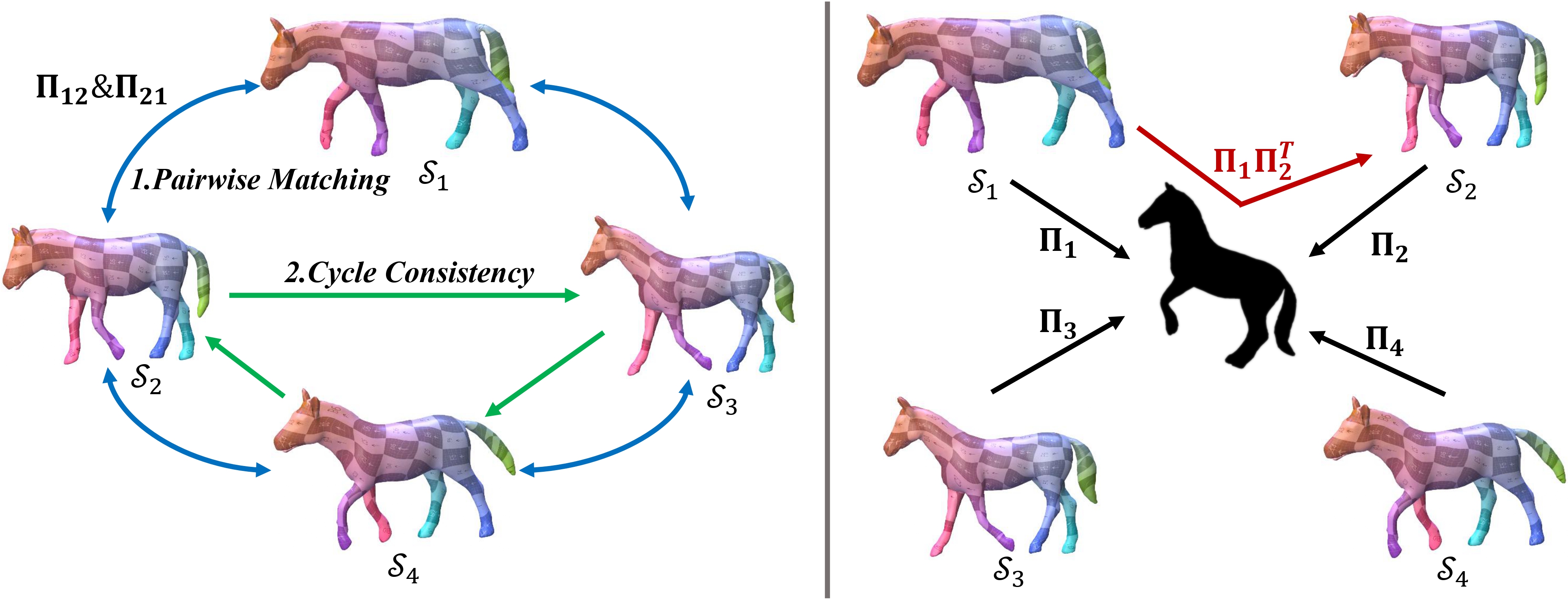 DcMatch: Unsupervised Multi-Shape Matching with Dual-Level ConsistencyTianwei Ye, Yong Ma, and Xiaoguang Mei†In AAAI, 2026
Establishing point-to-point correspondences across multiple 3D shapes is a fundamental problem in computer vision and graphics. In this paper, we introduce DcMatch, a novel unsupervised learning framework for non-rigid multishape matching. Unlike existing methods that learn a canonical embedding from a single shape, our approach leverages a shape graph attention network to capture the underlying manifold structure of the entire shape collection. This enables the construction of a more expressive and robust shared latent space, leading to more consistent shape-touniverse correspondences via a universe predictor. Simultaneously, we represent these correspondences in both the spatial and spectral domains and enforce their alignment in the shared universe space through a novel cycle consistency loss. This dual-level consistency fosters more accurate and coherent mappings. Extensive experiments on several challenging benchmarks demonstrate that our method consistently outperforms previous state-of-the-art approaches across diverse multi-shape matching scenarios. Code is available at https://github.com/YeTianwei/DcMatch.
@inproceedings{ye2025dcmatch, author = {Ye, Tianwei and Ma, Yong and Mei, Xiaoguang}, title = {DcMatch: Unsupervised Multi-Shape Matching with Dual-Level Consistency}, booktitle = {AAAI}, year = {2026} } - AAAI 2026
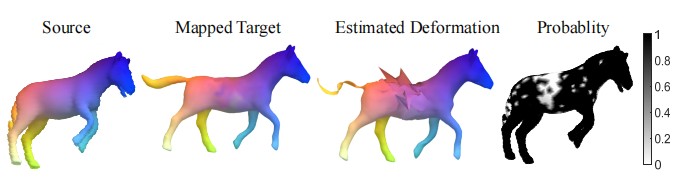 Probabilistic Deformation Consistency for Unsupervised Shape MatchingYifan Xia, Tianwei Ye, Jun Huang, Xiaoguang Mei , and Jiayi Ma†In , 2026
In this paper, we propose a novel unsupervised shape matching framework based on probabilistic deformation consistency in the spectral domain, termed as PDCMatch. Axiomatic optimization methods suffer from expensive geodesic distance calculations and vulnerability to local optima, and learning-based methods typically lack geometric consistency in pointwise correspondences. To overcome both limitations, we develop a non-Euclidean probabilistic deformation model that jointly estimates the underlying deformation and the correspondence probability via a linear Expectation-Maximization procedure. Building on this formulation, we further design a task-specific deformation loss that explicitly encourages geometric smoothness and structural consistency in an unsupervised manner. This tailored loss function plays a central role in improving the matching performance across challenging scenarios. Extensive experiments on public benchmarks involving near-isometric shapes, anisotropic meshing, cross-dataset generalization, topological noise, and non-isometric shapes demonstrate that our method consistently outperforms state-of-the-art methods, highlighting both its effectiveness and generalizability.
@inproceedings{xia2026prob,
  author = {Xia, Yifan and Ye, Tianwei and Huang, Jun and Mei, Xiaoguang and Ma, Jiayi},
  title = {Probabilistic Deformation Consistency for Unsupervised Shape Matching},
  year = {2026}
}


2025
- AAAI 2025
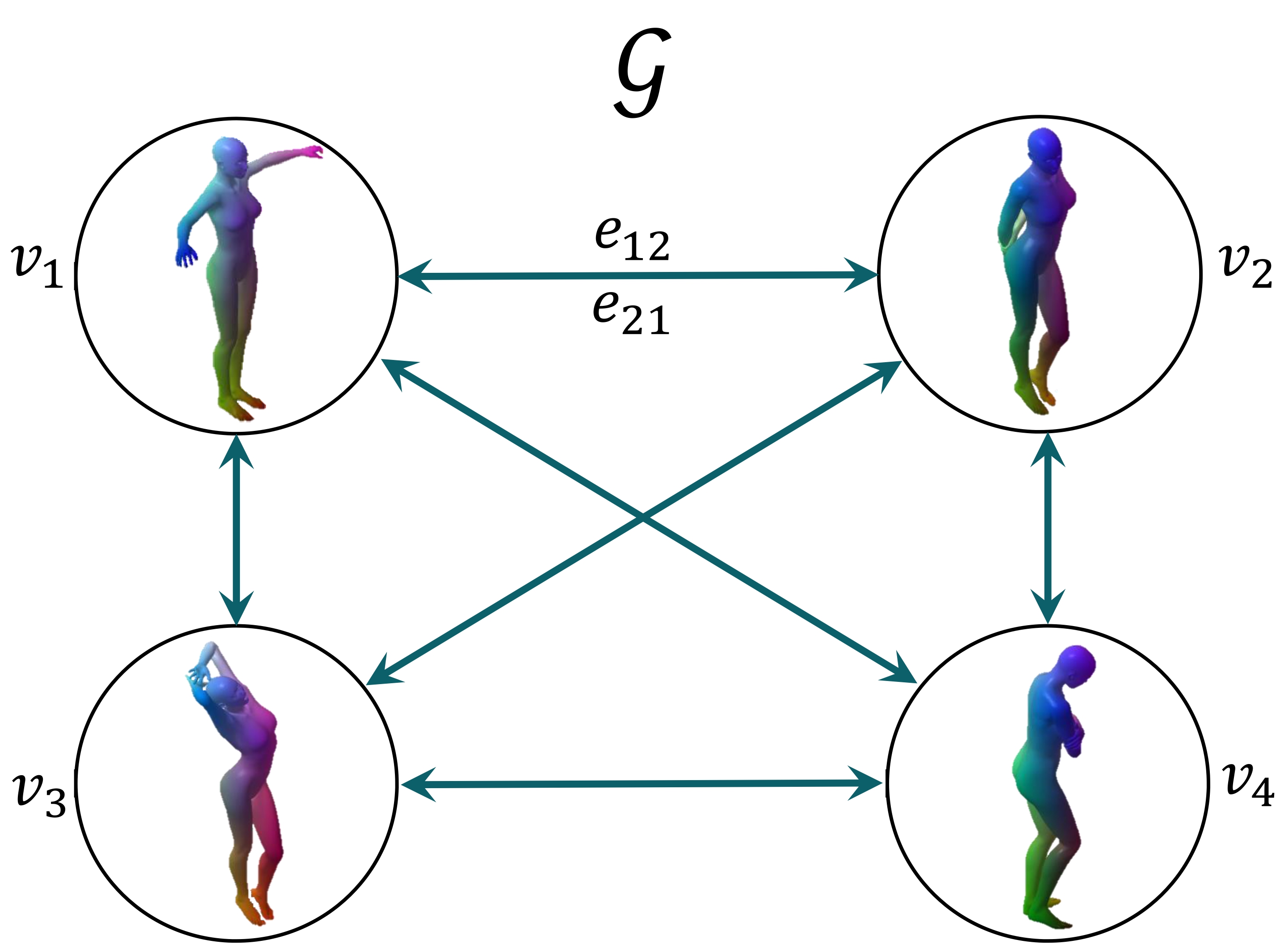 Multi-Shape Matching with Cycle Consistency Basis via Functional MapsIn AAAI, 2025
Multi-shape matching is a central problem in various applications of computer vision and graphics, where cycle consistency constraints play a pivotal role. For this issue, we propose a novel and efficient approach that models multi-shapes as directed graphs for two-stage optimization, i.e., optimizing pairwise correspondence accuracy using landmarks, and refining matching consistency through cycle consistency basis. Specifically, we utilize local mapping distortion to identify landmarks and extract the dimension of the functional space, which is then used to upsample in the spectral domain, thereby producing smoother results. Next, to optimize the consistency of correspondences, we introduce the cycle consistency basis, which succinctly describes all consistent cycles in the collection. We then propose cycle consistency refinement, which resolves inconsistencies in cycles efficiently via the alternating direction method of multipliers. Our approach simultaneously balances the accuracy and consistency of multi-shape matching, achieving lower correspondence errors. Extensive experiments on several public datasets demonstrate the superiority of our approach over current state-of-the-art methods.
@inproceedings{xia2025multi,
  author = {Xia, Yifan and Ye, Tianwei and Zhou, Huabing and Wang, Zhongyuan and Ma, Jiayi},
  title = {Multi-Shape Matching with Cycle Consistency Basis via Functional Maps},
  booktitle = {AAAI},
  volume = {39},
  number = {8},
  pages = {8575--8583},
  year = {2025}
}
