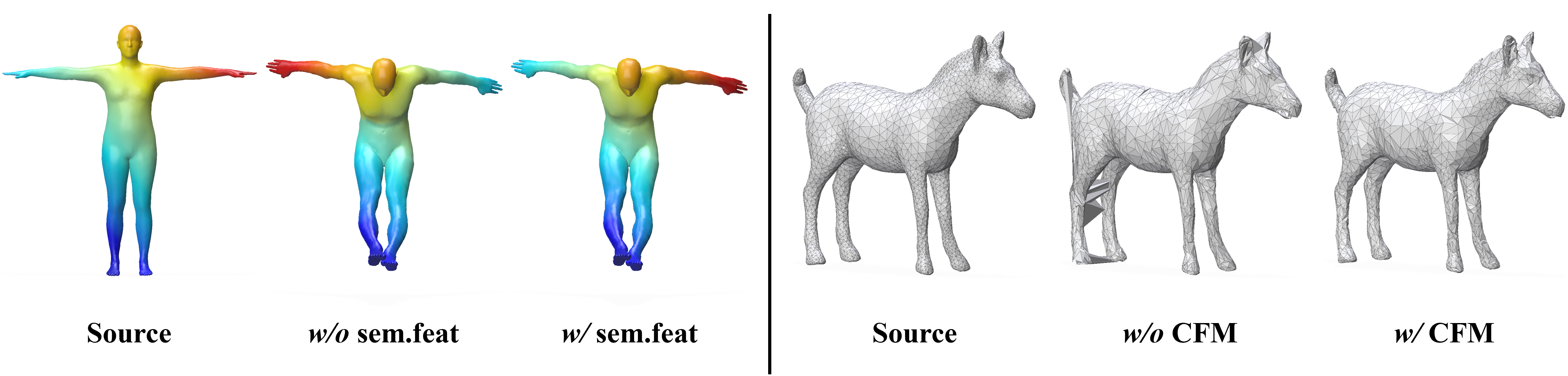
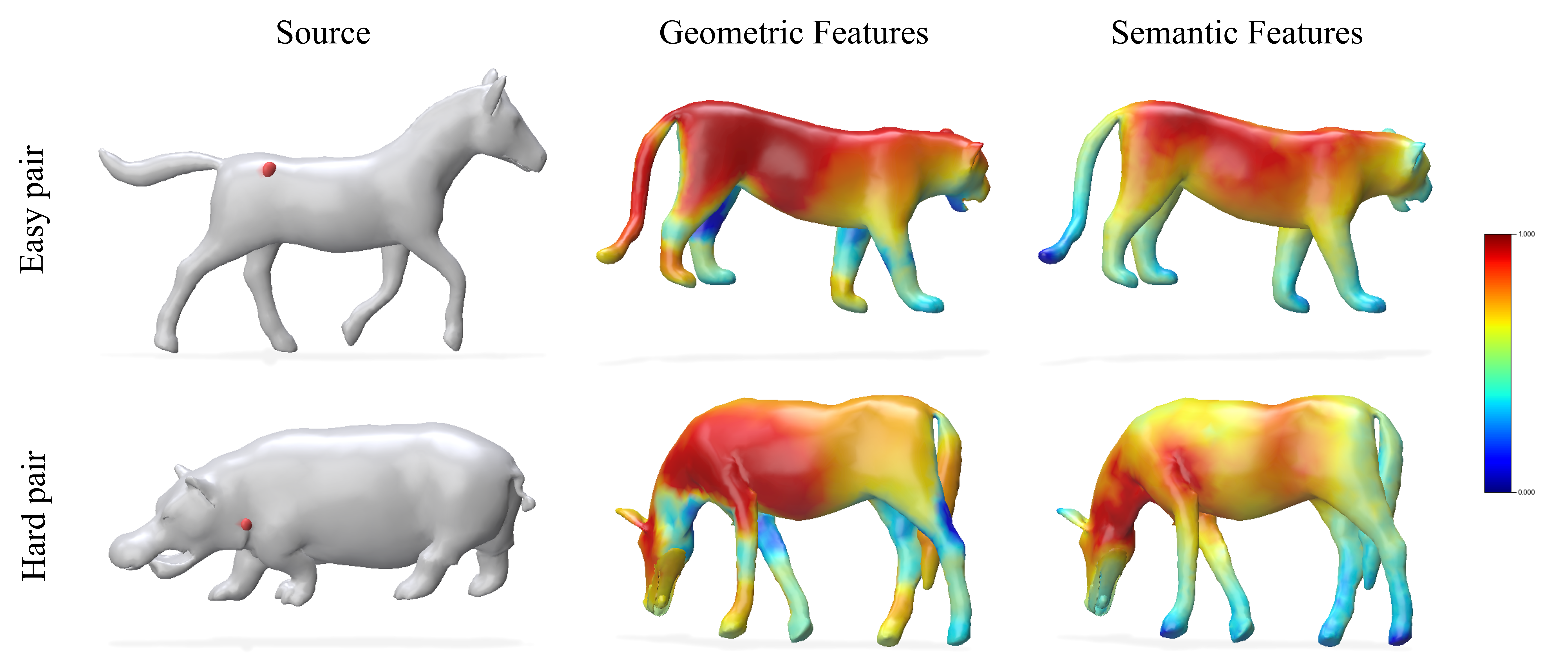
Intrinsic descriptors can confuse symmetric or self-similar parts, such as left-right limbs, because local geometry does not always identify semantic correspondence.
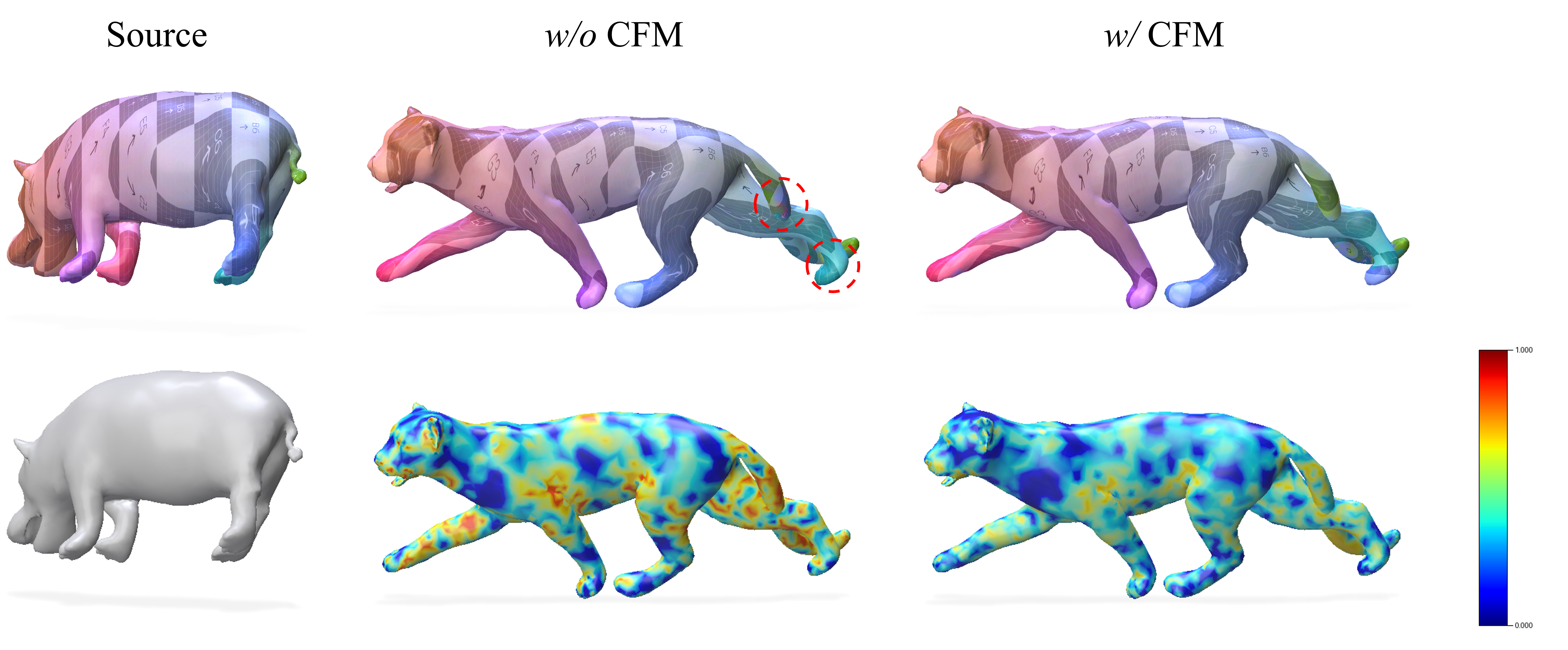
Spectral functional maps provide a compact matching space, but dense projection can still introduce local mismatches that appear as noisy correspondence transitions.
Establishing accurate point-to-point correspondences between non-rigid 3D shapes remains a critical challenge, particularly under non-isometric deformations and topological noise. Existing functional map pipelines suffer from ambiguities that geometric descriptors alone cannot resolve, and spatial inconsistencies inherent in the projection of truncated spectral bases to dense pointwise correspondences. In this paper, we introduce SGMatch, a learning-based framework that couples 3D-lifted semantic cues with trajectory-level feature transport regularization. Specifically, we design a Semantic-Guided Local Cross-Attention module that integrates semantic features from vision foundation models into geometric descriptors while preserving local structural continuity. Furthermore, we adapt conditional flow matching as a time-conditioned feature transport regularizer that promotes spatially coherent point-wise recovery. Experimental results on multiple benchmarks demonstrate that SGMatch achieves competitive performance across near-isometric settings and consistent improvements under non-isometric deformations and topological noise.
SGMatch combines lifted semantic cues, local feature fusion, functional maps, and flow-based feature transport to recover accurate and spatially coherent non-rigid correspondences.
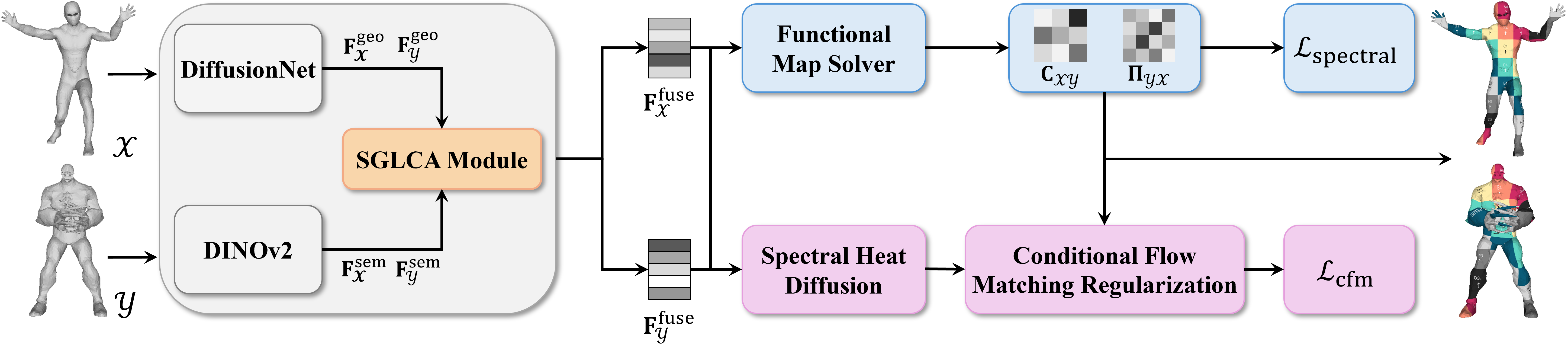
Overview of SGMatch. Given a pair of shapes, we extract geometric and semantic features, fuse them via SGLCA, estimate functional maps, and regularize correspondences through spectral heat diffusion and conditional flow matching.
Depth- and normal-guided multi-view renderings are encoded by frozen DINOv2 and back-projected to mesh vertices, providing semantic cues that complement DiffusionNet geometry.
SGLCA uses semantic-guided gates and local cross-attention to inject part-level context while preserving neighborhood structure on the surface.
Fused descriptors estimate bidirectional functional maps, while heat diffusion and conditional flow matching regularize dense point-wise recovery through coherent feature transport.
SGMatch matches state-of-the-art performance in near-isometric settings and brings clearer gains under non-isometric deformation and topological noise, where semantic cues and flow regularization are most beneficial.
Mean geodesic error (×100) on FAUST, SCAPE (near-isometric) and SHREC'19 (cross-dataset generalization).
| Method | FAUST | SCAPE | SHREC'19 |
|---|---|---|---|
| Axiomatic Methods | |||
| ZoomOut | 6.1 | 7.5 | - |
| Smooth Shells | 2.5 | 4.2 | - |
| DiscreteOp | 5.6 | 13.1 | - |
| Supervised Methods | |||
| FMNet | 11.0 | 33.0 | - |
| GeomFMaps | 2.6 | 3.0 | 7.9 |
| Unsupervised Methods | |||
| Deep Shell | 1.7 | 2.5 | 21.1 |
| DUO-FMNet | 2.5 | 4.2 | 6.4 |
| AttnFMaps | 1.9 | 2.2 | 5.8 |
| ULRSSM | 1.6 | 1.9 | 4.6 |
| HybridFMap | 1.5 | 1.8 | 3.6 |
| DenoisFMap | 1.7 | 2.1 | 3.6 |
| DiffuMatch | 1.9 | 4.4 | 3.9 |
| DeepFAFM | 1.5 | 1.9 | 3.6 |
| Ours | 1.4 | 1.8 | 3.3 |
Mean geodesic error (×100) on SMAL and DT4D-H. Our method achieves the best overall performance on SMAL, surpassing the previous state-of-the-art by 24%.
| Method | SMAL | DT4D-H (intra) | DT4D-H (inter) |
|---|---|---|---|
| Axiomatic Methods | |||
| ZoomOut | 38.4 | 4.0 | 29.0 |
| Smooth Shells | 30.0 | 1.2 | 6.4 |
| DiscreteOp | 38.1 | 3.6 | 27.6 |
| Supervised Methods | |||
| FMNet | 42.0 | 9.6 | 38.0 |
| GeomFMaps | 8.4 | 1.9 | 4.2 |
| Unsupervised Methods | |||
| Deep Shell | 29.3 | 3.4 | 31.1 |
| DUO-FMNet | 6.7 | 2.6 | 15.8 |
| AttnFMaps | 5.4 | 1.7 | 11.6 |
| ULRSSM | 3.9 | 0.9 | 4.1 |
| HybridFMap | 3.3 | 1.0 | 3.5 |
| DenoisFMap | 4.3 | 5.8 | 16.9 |
| DiffuMatch | 10.1 | 1.8 | 8.6 |
| DeepFAFM | 3.8 | 0.9 | 3.9 |
| Ours | 2.5 | 1.0 | 3.4 |
Mean geodesic error (×100) on TOPKIDS. Our method achieves a 42% improvement over the previous best.
| Method | TOPKIDS |
|---|---|
| Axiomatic Methods | |
| ZoomOut | 33.7 |
| Smooth Shells | 10.8 |
| DiscreteOp | 35.5 |
| Unsupervised Methods | |
| Deep Shell | 13.7 |
| AttnFMaps | 23.4 |
| ULRSSM | 9.2 |
| HybridFMap | 5.0 |
| DeepFAFM | 6.2 |
| Ours | 2.9 |
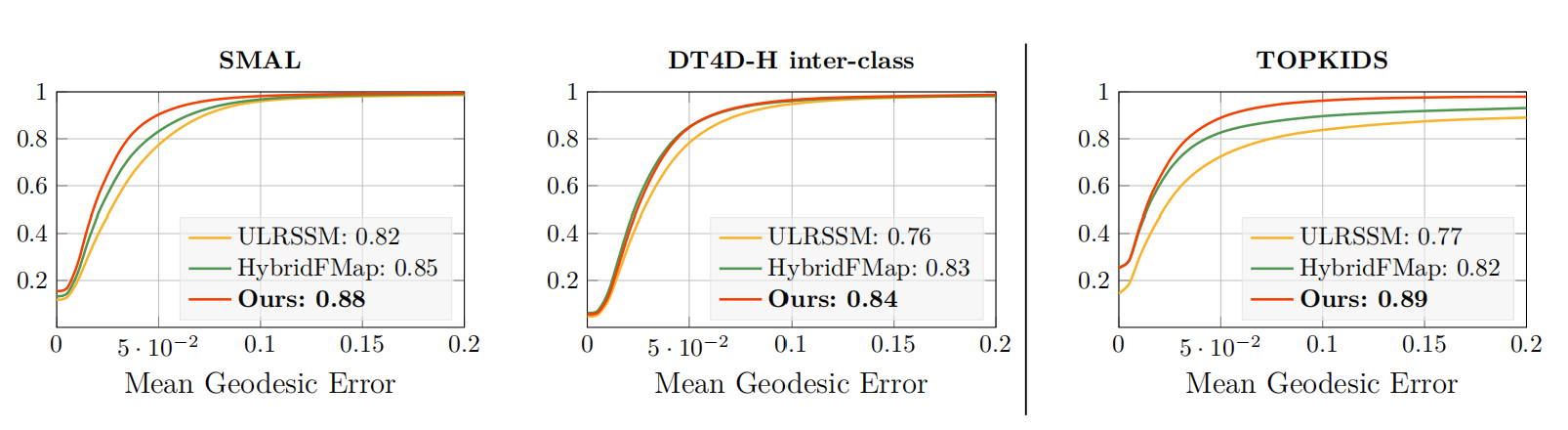
PCK curves and AUC values on SMAL, DT4D-H inter-class, and TOPKIDS. SGMatch consistently improves the area under the curve in challenging non-isometric and topology-noisy settings.
Beyond point-wise geodesic accuracy, we evaluate the local smoothness of recovered maps using conformal distortion, surface coverage, Dirichlet energy, and bijectivity. SGMatch improves most metrics, with the clearest gains on non-isometric and topology-noisy datasets where intrinsic geometry is less reliable.
| Metric | Method | FAUST | SCAPE | SHREC'19 | SMAL | DT4D-inter | TOPKIDS |
|---|---|---|---|---|---|---|---|
| Conf. ↓ | HybridFMap | 0.654 | 0.779 | 1.030 | 2.473 | 1.866 | 3.201 |
| Ours | 0.639 | 0.764 | 0.787 | 1.956 | 1.563 | 2.517 | |
| Cov. (%) ↑ | HybridFMap | 83.3 | 82.5 | 75.9 | 65.0 | 67.1 | 63.3 |
| Ours | 83.5 | 81.9 | 76.1 | 71.2 | 66.3 | 63.9 | |
| Dir.E ↓ | HybridFMap | 2.96 | 3.11 | 12.30 | 19.29 | 8.44 | 98.30 |
| Ours | 2.95 | 3.27 | 6.30 | 10.20 | 8.70 | 48.33 | |
| Bij. ↓ | HybridFMap | 0.0049 | 0.0060 | — | 0.0285 | 0.0130 | — |
| Ours | 0.0052 | 0.0064 | — | 0.0175 | 0.0166 | — |
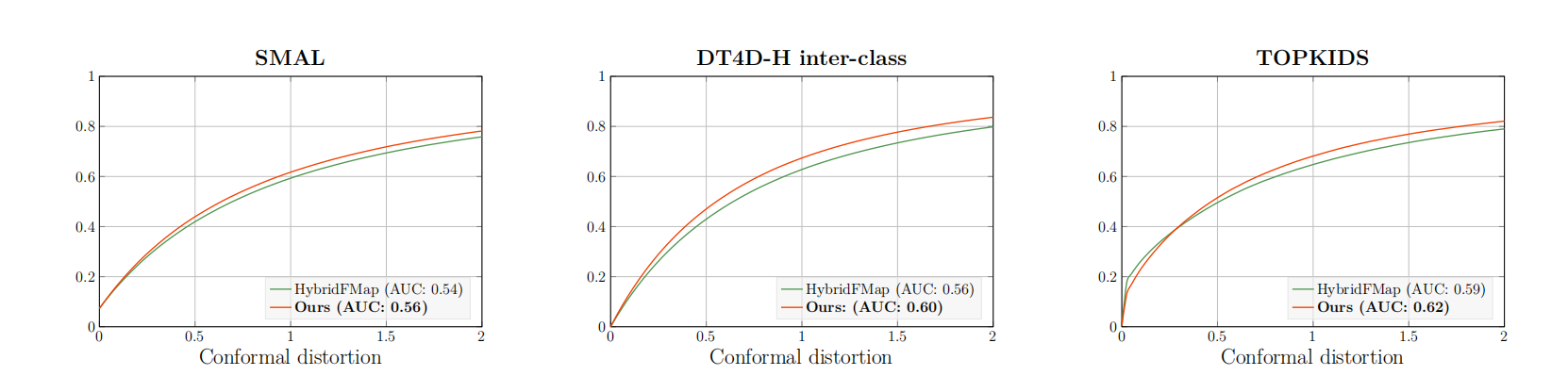
Conformal-distortion-based smoothness comparison on SMAL, DT4D-H inter-class, and TOPKIDS. Higher curves indicate more correspondences under a given distortion threshold.
We isolate the contribution of CFM by comparing it with endpoint matching, cycle consistency, and synchronous diffusion under the same SGMatch backbone. We also ablate the main feature-fusion components on SMAL.
| Variant | SMAL | TOPKIDS | |||||||
|---|---|---|---|---|---|---|---|---|---|
| Geo. ↓ | Conf. ↓ | Dir.E ↓ | Bij. ↓ | Cov. ↑ | Geo. ↓ | Conf. ↓ | Dir.E ↓ | Cov. ↑ | |
| w/o CFM | 2.7 | 2.32 | 10.55 | 0.0210 | 66.8 | 3.4 | 2.92 | 45.64 | 63.5 |
| Endpoint-only | 2.7 | 2.46 | 14.37 | 0.0225 | 65.0 | 3.4 | 2.76 | 50.92 | 63.8 |
| Cycle-consistency | 2.8 | 2.29 | 10.53 | 0.0201 | 67.2 | 3.4 | 2.75 | 42.42 | 63.7 |
| Sync. Diff. | 2.6 | 2.45 | 13.48 | 0.0221 | 64.7 | 3.5 | 2.79 | 50.14 | 63.8 |
| Ours | 2.5 | 1.96 | 10.20 | 0.0175 | 71.2 | 2.9 | 2.52 | 48.33 | 63.9 |
| Variant | Geo. | Sem. | Gating | Attention | Heat Diff. | CFM | Geo.Err ↓ |
|---|---|---|---|---|---|---|---|
| Geo. only | — | — | 3.2 | ||||
| Sem. only | — | — | 21.2 | ||||
| Gating only | none | 3.6 | |||||
| Local attention only | local | 2.6 | |||||
| Gating + global attention | global | 2.6 | |||||
| w/o heat diffusion | local | 3.0 | |||||
| Ours | local | 2.5 |
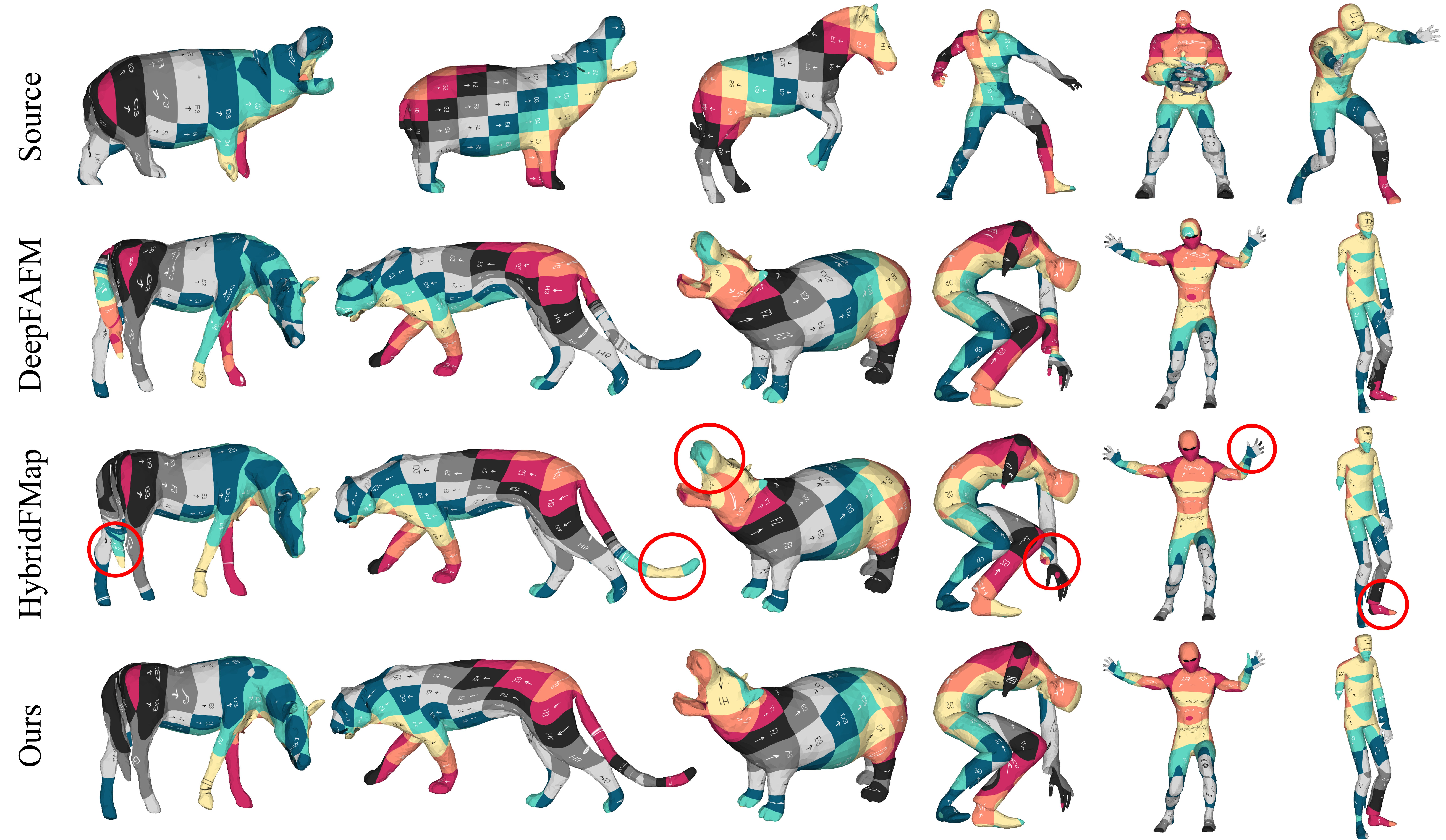
Qualitative results on SMAL and DT4D-H. Comparison of our method against DeepFAFM and HybridFMap via texture transfer. Our method produces more accurate and coherent correspondences.
@inproceedings{ye2026sgmatch,
  title     = {SGMatch: Semantic-Guided Non-Rigid Shape Matching with Flow Regularization},
  author    = {Ye, Tianwei and Mei, Xiaoguang and Xia, Yifan and Fan, Fan and Huang, Jun and Ma, Jiayi},
  booktitle = {European Conference on Computer Vision (ECCV)},
  year      = {2026}
}